
Bel Air North City Directory Collections
Bel Air North never grew a bound local directory. As an unincorporated census-designated place in Harford County, it leans on a countywide telephone and address trail. The backbone is a long run of the Chesapeake and Potomac Telephone Company of Baltimore City directory. A digitized Library of Congress reel deepens it. So does its inventory of Harford County criss-cross directories. Newspapers, the Maryland Room, and the Historical Society fill the gaps between those runs. Search the postal locality and the street spelling too. The telephone exchange can matter as much as the Bel Air North label.
| Bel Air North collection | Years available | Where held | How to use it |
|---|---|---|---|
| Chesapeake and Potomac Telephone Company, Harford County Telephone Directory | 1936–1947, with annual availability to confirm | Maryland Historical Trust survey bibliography and local collection leads | Alphabetical subscriber and business clue |
| Library of Congress Harford County white and yellow pages | September 1960–September 1962 | Library of Congress online item | Digitized images, text, and PDF |
| Harford County criss-cross directories | 1966–1996 inventory | Library of Congress address-directory guide | Request the exact year and address range |
| The Aegis & Intelligencer and Bel Air Times | 1864–1923; 1881–1941 publication run | Library of Congress and Maryland State Archives | Notices, deaths, land sales, businesses, and local context |
Never plug a missing year with a guess. The public catalog does not list every Harford criss-cross volume, its publisher, or its abbreviation key. A blank search has many innocent causes. The subscriber may simply be unlisted. A rural-route form, a different exchange, or a missing annual volume can all hide a household. Some directories covered only part of the telephone-service territory. So when you ask a library or archive for help, request the directory type, the exact place, and the year. Note: A Bel Air mailing address can point to the Town, the CDP, or another county area, so confirm the geography before treating an entry as local.
Bel Air North Directory Geography
No town clerk serves Bel Air North. It is a Census-defined place, not an incorporated town, so no municipal directory exists for it. Harford County agencies serve the unincorporated area. Meanwhile the county seat, courthouse, library, and much of the archival material sit physically in Bel Air. The Town of Bel Air incorporated in 1874. Yet its staff lists and town systems track town government, not every address carrying a Bel Air postal label. Match the listing to a street or parcel first. Only then assign it to Bel Air North.
Older records shift names for the same reason. One year may show a county locality, a town name, or a rural exchange for the same household. The county seat moved to Bel Air in 1782, long before anyone drew the modern CDP label. So an early record's correct home can be Harford County even when a later map says Bel Air North. Treat each directory entry as a dated location clue, never a modern geographic ruling.
Bel Air North Newspaper Directory Clues
The Aegis & Intelligencer has no rival here. It is the clearest digitized newspaper run for the Bel Air area. Issues span 1864 through 1923. A surname or a road name can surface in legal notices, estate matters, marriages, death notices, businesses, churches, and social items. The title record counts 2,383 digitized issues. That breadth makes the paper a fine companion to any directory search. Check each notice's date and locality before tying it to a Bel Air North household, and see the Maryland State Archives record for Bel Air Times before planning a microfilm search.
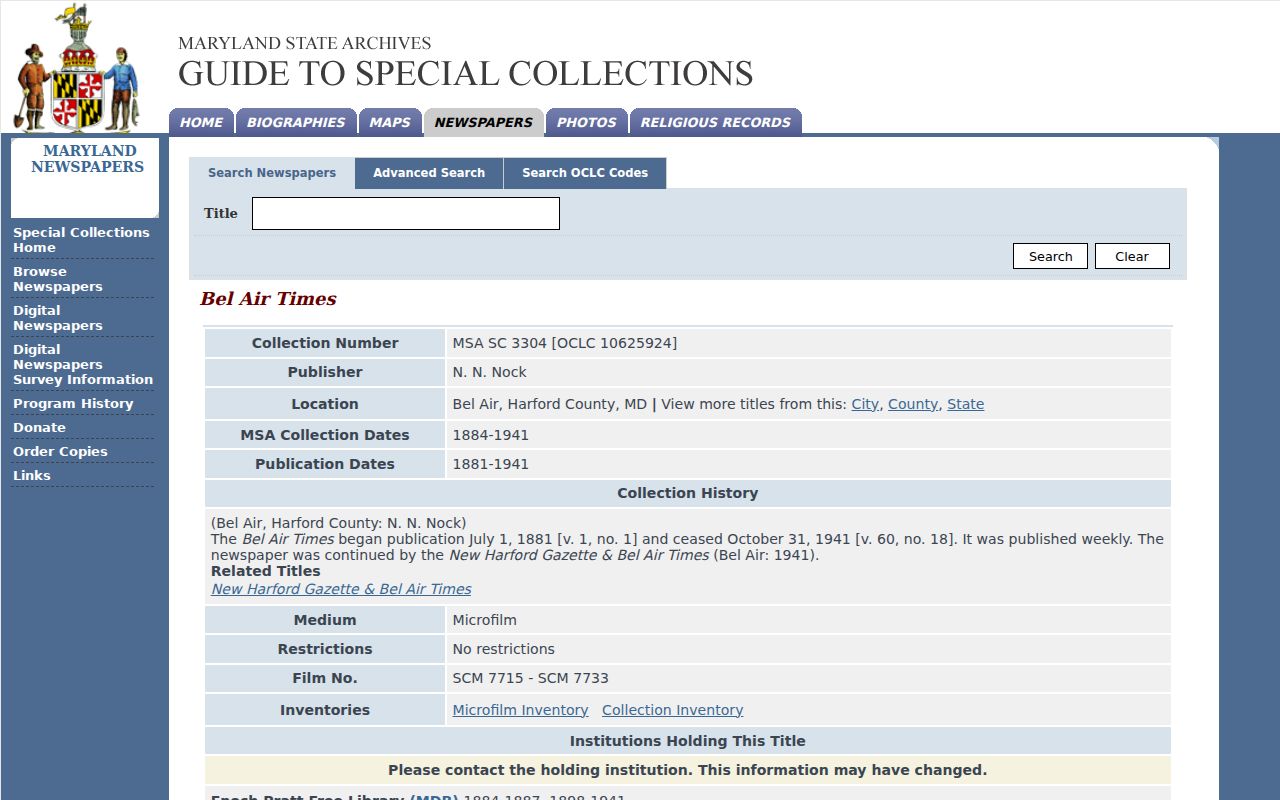
The record sketches a weekly publication history and names the institutions that hold the paper. Use it as a supplement. It cannot replace date-specific telephone-listing evidence. Later newspaper access may run through the library or another subscription channel. Confirm the exact title run before any visit. For a historical name, pair the surname with a road, church, estate, or sale term, and remember that a missing obituary is a gap, not proof a subscriber died or left the county.
Bel Air North Maryland Room Research
The Bel Air Branch of Harford County Public Library anchors local historical research. Its Maryland Room is the draw. Inside sit microfilm and microfiche reading, public computers, oral histories, and genealogy material. It also opens the Harford Heritage Digital Archives. FamilySearch affiliate access adds restricted images. Those appear at the branch's public computers. The public web pages publish no verified year-by-year run of Bel Air directory volumes. No complete obituary index appears there either. A focused request beats a broad search, and the Harford County Public Library local-history resources page lists the catalog, Bulletin index, digital archives, and research channels.
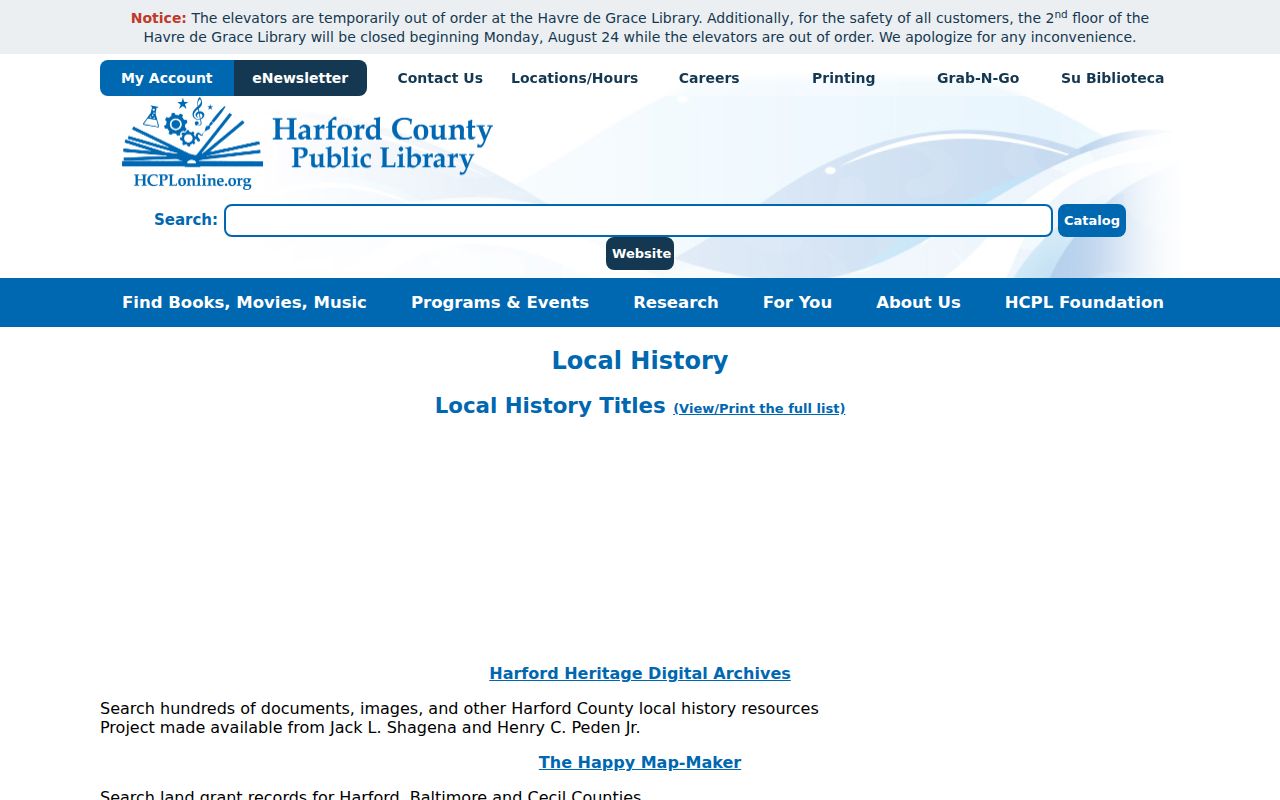
Those links sharpen a fuzzy request. Name the type you need: telephone, street-address, criss-cross, or city-business directory. Add the locality and the exact year. Ask whether the volume covers the whole county, one exchange, or a smaller service area. The Harford Historical Bulletin subject index helps too. It points to people, places, and events without being a complete name roll, so save the issue and page citation before relying on it.
Reading a Bel Air North City Directory
A 1960–1962 Library of Congress directory volume opens with locality facts. It then splits into alphabetical white pages and yellow pages. Each white-page line carries a name. Often that name comes with initials or a title like Mrs.. The entry may then list a street or rural-road address. It may also carry a telephone exchange and number. Businesses and institutions show up too, in place of a household. A spouse or second adult appears only when the subscriber chose that form. So the line is evidence of one subscriber at one moment, not a census of everyone under that roof.
| Name form | Record initials, titles, suffixes, and the spelling shown. They help distinguish similar names. |
|---|---|
| Street or rural route | Capture the number, road name, rural-route notation, and locality heading exactly as printed. |
| Exchange and number | Keep the telephone exchange with the date. An exchange can guide a search when the CDP label fails. |
| Listing type | Mark the item as residential, business, institutional, white-page, or yellow-page evidence. |
| Page and image | Save the directory year plus page or image identifier so another researcher can repeat the check. |
- Criss-cross directory
- An address-oriented directory that starts with a street or address and leads to a subscriber or occupant listing for that volume.
- Householder index
- An alphabetical finding tool for a household name. It is not a guarantee that every household member appears.
- Abbreviation key
- The directory's own explanation of shortened terms and symbols. Photograph or transcribe it when the volume supplies one.
Criss-cross results deserve the same caution. The Library of Congress inventory documents a Harford County series running from 1966 to 1996, yet it does not place every annual volume or every field online. Ask for the exact year you need. Then note whether the hit is an address, a subscriber, or some other listing type before drawing conclusions.
Bel Air North Directory Archive Routes
When the web collection runs dry, turn to the custodian. They hold the kind of evidence you want. The Historical Society of Harford County keeps original documents, maps, plats, deeds, letters, diaries, ledgers, court and business papers, and cemetery leads. It also houses the Henry C. Peden research library. Its PastPerfect catalog includes obituary material starting in September 2007, marriage-index leads for 1865–1931, and a master family index. It also holds further discovery records. A catalog hit tells you where to ask next. It does not hand you a current address or a full obituary text. Review the Historical Society in-person research information before setting up an appointment.

The Society's collection can also fill a directory year that is missing online. Frame a focused query naming a person, tract, road, approximate year, and record type. Its published pages carry differing fee language. So confirm current appointment and price terms directly instead of carrying an older charge into your research plan.
Federal census schedules add a household check for released census years. Pair a nearby census with the telephone or criss-cross volume. Then compare the address against a deed, estate file, or newspaper notice. Remember that the 1890 population schedules were largely destroyed. An 1890 gap therefore has a national cause, not a local disappearance.
Tracing Bel Air North City Directory Households
For family history, treat a dated directory trail as a sequence. Start with the exact address from an old deed or parcel record. Keep the historic street spelling and any rural-route wording. Follow the name through the available telephone years. Then test the address against census, newspaper, land, and estate material. The sequence can reveal a move. It can also show a change in subscriber, or a gap in the source. It cannot by itself prove a death, a vacancy, or who occupies a modern address.
- Write down the street address, historical spelling, road name, and any rural-route notation from the oldest reliable record.
- Locate the closest telephone directory and capture the year, locality heading, page or image, exchange, and listing type.
- Check the corresponding criss-cross directory when the requested Harford volume is available, noting whether it returns a street-to-subscriber clue.
- Search newspaper issues near that date for the surname, address, land sale, marriage, estate, or death notice.
- Pair the clue with the nearest released federal census, then verify property continuity through a deed or estate record.
Carrying a historical address into the current parcel system takes care. The MDLandRec portal works through a grantor, grantee, and book-page approach. A property card can supply the deed reference. It can also give the legal description needed to locate the instrument. A name hit in a directory still needs that property or court corroboration. For a modern identity question, use the separate Bel Air North resident lookup workflow instead.
Note: Preserve the source date, page, spelling, and record type for every entry. Each directory reflects a different time and purpose.
Bel Air North Directory Record Timeline
The historical shelf shows several clear handoffs. Harford land-record series begin in 1773. County government formed in 1774. The county seat moved to Bel Air in 1782. The Town incorporated later, in 1874, while Bel Air North sits outside that municipal identity. Telephone material, newspapers, and archive indexes all rest on that county record structure. Later digital portals do too. Knowing the handoff stops a searcher from expecting a town office to hold every CDP record.
| 1773–1774 | Harford land-record series begin and county government forms, creating the earliest county-level filing context. |
|---|---|
| 1782–1874 | The county seat moves to Bel Air, then the Town of Bel Air incorporates. Town and county records must be kept distinct. |
| 1936–1996 | Verified telephone and criss-cross directory leads provide date-specific address-to-subscriber paths. |
| Current access | Library, archive, land-record, and census channels preserve different slices of the historical trail. |
Keep an access date with each digital citation. Portal accounts, image availability, and payment rules can change. A paper or microfilm record may still be the best route for a particular year.